Ateliers
If the world is an open atelier and society is a sculpture that is in a state of constant becoming through our actions, where do we learn to orient ourselves, to co-create with others and to hold the dynamic and uncertain tension between what we hope to make and what unfolds before us?
In social life we constantly form improvised and emergent collectives that are in constant motion; in a tram, in a class, in a team, or at a party. In the Workspace for Social Sculpture we aim to foster space to reflectively experience – and expression – becoming a temporary community through artistic collaboration. For this we organise ateliers in which we can experience and practise together.
In the Ateliers create spaces for embodied inquiry, where action and reflection happen together. We work slowly, deliberately, and in response to what emerges. For us praxis is the ongoing movement between experience and reflection, between what we do and how we understand it. It is a way of entering into relationship with others and with the social field that holds us.
Our approach to research is not about collecting data from others, but about creating shared spaces of inquiry rooted in lived experience. In this way, an atelier becomes a place where new questions, patterns, and possibilities can emerge, supporting both individual learning and institutional change. Here aesthetic and embodied practices can give rise to forms of knowledge that are difficult to access through traditional methods.
Our Work


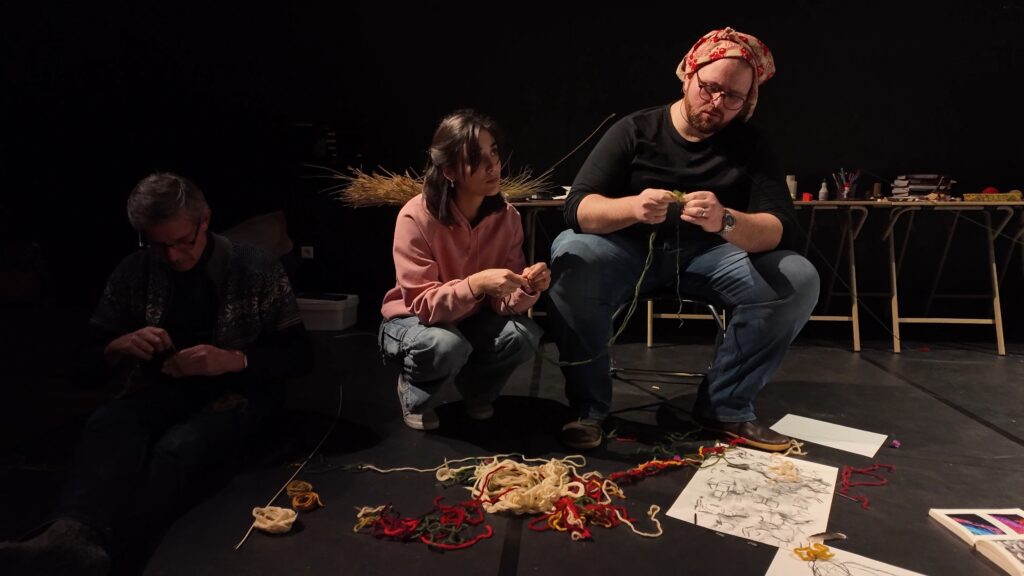


Atelier Safety & Risk
ArtEZ Academie of Theatre & Dance,
Arnhem – 2024
Atelier Individuality & Belonging
ArtEZ Academie of Theatre & Dance
Arnhem – 2024
Atelier Equality & Inequality
Hogeschool Leiden
Leiden – 2025
Atelier Chaos & Control
Hogeschool Leiden
Leiden – 2025
Atelier Individual & Group
Landelijke Kenniscentrum voor Cultuureducatie en Amateurkunst (LKCA)
Utrecht – 2025
Atelier Safety & Risk
Sectoral Advies Commissie Kunstonderwijs
Willem de Koning Academie, Rotterdam – 2025
Atelier Inclusion & Exclusion
ArtEZ Academie of Theatre & Dance
Zwolle – 2025
Atelier Sameness & Difference
ArtEZ Academie of Theatre & Dance
Arnhem – 2025
Atelier Resistance & Surrender
ArtEZ Academie of Beeldende Kunst BEAR
Arnhem – 2025
Atelier Involvement & Detachment
College van Bestuur of the Gerrit Rietveld Academie
Amsterdam – 2025
Atelier of Impotence
Eer en Waardeer Netwerk voor Jongerenwerkers
Amsterdam – 2025
Atelier of Impotence
Verus Vereeniging van Schoolbesturen
Leiden – 2025
Atelier Safety & Danger
Alliantie Dans Veilig
The Hague – 2026
Atelier Safety & Danger
Velon Congress
Amsterdam – 2026
Atelier of Porosity
Dutch Association for Group Psychotherapy (NVGP)
Driebergen – 2026
Ongoing Projects
Atelier of Impotence / Atelier van de Onmacht (Ongoing)


On a regular basis, usually on the third Friday of the month, we organize the Atelier of Impotence. Through dialogue and artistic practice we create space for the impotence and disempowerment we experience in the current times. The Atelier of Impotence is designed by artist Lotte van den Berg, in close collaboration with educator Saar Frieling and Flemish philosopher Christine Gruwez. For several decades, Christine has been exploring the possibility of becoming a fellow contemporary in a world where, at first glance, we are condemned to mere observation. Christine wrote a book about this, Meditations on Disempowerment (Meditaties over Onmacht), which inspired us to start the Atelier. Experiencing impotence and disempowerment is part of being human. Just as we are mortal, we are also fundamentally disempowered; unable to do and bear everything we hope, wish, and want. In the face of genocide, ecocide, and structural inequality, it is impossible to let that sink in. I am an eyewitness and therefore a fellow contemporary of these horrors; I even feel complicit, but I cannot make it stop, now. As unbearable as it is, it is also important to truly feel this. “I can’t do it. I can’t bear to watch it. I can’t bear it. I can’t change it.” It is precisely in this fundamentally human experience that we find access to ourselves and to each other. We find the opportunity to question the patterns of arrogance in which we have become entangled.
During an Atelier of Impotence, dialogue, contemplation, and artistic exploration go hand in hand. Impotence and disempowerment cannot be captured in dialogue, silence, or art, but by switching between these three, we can learn to tolerate its presence and experience how the disempowerment we feel is (also) a source of humanity and community spirit.
Equity-Based Pedagogy / Gelijkwaardige Pedagogiek at ArtEZ Academy of Theatre & Dance

Equity-based pedagogy grows from a simple but demanding recognition: learning is never neutral, and artistic education is always already shaping whose voices are heard, which bodies feel legitimate, and what forms of knowledge are treated as real. Rather than treating equity as an add-on, a compliance framework, or a set of fixed rules, we work with it as a living orientation to pedagogical and institutional life, one that needs to be practised, revised, and carried over time.
At ArtEZ Academy of Theatre & Dance, the series of ateliers listed above formed part of the research process through which this orientation was developed. These gatherings were not “illustrations” of a policy written elsewhere; they were studio-based inquiry spaces where staff, students, and leaders could work with live paradoxes, notice patterns in the pedagogical and institutional field, and experiment with forms of dialogue, participation, and shared responsibility that could later be translated into an equity-based pedagogical vision.
In this work, equity is held as a generative paradox rather than a problem to solve once and for all. The tensions that run through education and organisational life, such as safety and risk, individuality and belonging, inclusivity and boundaries, equality and inequality, are not contradictions to tidy away; they are conditions that require skill in relationship, in governance, and in the everyday craft of teaching and learning. An equity-based pedagogy therefore asks for dialogical action and for keeping the complex as complex, so that people can stay in contact with what is really happening, even when certainty would be easier.
Methodologically, the approach is practice-based and participatory. It is shaped through dialogical inquiry, embodied artistic research, reflective practice, and the informal conversations where institutional life is actually made, rather than through top-down mandates detached from lived reality. This is why Workspace for Social Sculpture has been part of the work at ArtEZ: it treats the institution itself as sculptural material, makes the shaping of the social more visible, and creates spaces where students, staff, and leadership can rehearse new rhythms and forms of learning together.