Who we are…
Not without the Rose is a collaboration between an artist and a pedagogue and group-analytic therapist. We convene inquiry spaces where artistic practice, pedagogy, and governance can be held together as living praxis, particularly in contexts where complexity is real and where quick solutions tend to create more harm than help. Our work is for partners who sense that meaningful change requires more than good intentions and better documents, because it requires practices that can hold contradiction, contain anxiety, and help a group, organisation, or institution become more capable of learning in public, over time.
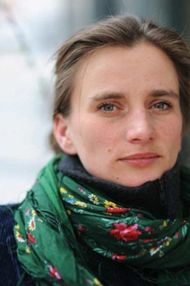
Lotte van den Berg
Lotte van den Berg is an artist, theatre-maker, and artistic researcher whose work is devoted to creating temporary public spaces among and in the midst of people, spaces where experimentation and learning can happen together. She has spoken of the most valuable spaces in art not as the theatre or the museum, but as the studio, the rehearsal room, the sketchbook, and the classroom, and she has set herself the task of shaping these rehearsal spaces for life and sharing them with as many different people as possible.
Her practice is marked by a precise attention to the dramaturgy of participation in the most concrete sense, including how people gather, how attention is held, how space is choreographed, and how form makes particular kinds of encounter possible. Over time, she has moved between theatre, performance, dance, and film, and she has consistently sought forms that make relationships visible not only within theatre institutions but in the wider social field, with audiences often invited into participation so that the work becomes a rehearsal of togetherness rather than a delivery of spectacle.
A central thread in Lotte’s trajectory has been her sustained exploration of dialogue as an aesthetic and social practice. From 2013 to 2022 she worked, together with Daan ’t Sas, Peter Aers and many others, on Building Conversation, a long-term dialogical art project inspired by conversation techniques and rituals from around the world, approaching conversation itself as a collective creation that can be rehearsed, revised, and deepened. This period culminated in the publication of Building Conversation – The Scripts, a resource that captures and shares the work’s repertoire of conversational forms.
Matthew Rich-Tolsma
Matthew Rich-Tolsma (he/him) is a South African group-analytic therapist, independent scholar, and artist-educator based between the Netherlands and South Africa. His work bridges clinical practice, pedagogy, and organisational development, supporting leaders, educators, and teams to stay in dialogue when pressure is high and the stakes are real. He brings together group analysis, critical pedagogy, and critical theatre, with a focus on how trust, authority, conflict, and belonging shape what becomes possible in groups.
Clinically, he works in private practice with individuals, couple, and groups in Amsterdam. He also teaches in clinical training, and leads reflective practice. As a teacher, he works across higher education, including teaching and supervision in arts education, organisational behaviour, and entrepreneurship and innovation.
He is an experienced Nonviolence practitioner and mediator, and has worked with humanitarians and community actors in contexts of armed conflict, including in Iraq, Syria, Sudan, and South Sudan.
Alongside rigorous facilitation and the design of learning processes, Matthew integrates mindful and embodied practice to support steadiness, discernment, and care. He is interested in the quieter dimensions of relational work as well, including attention, silence, and the felt sense of what is happening in a space.

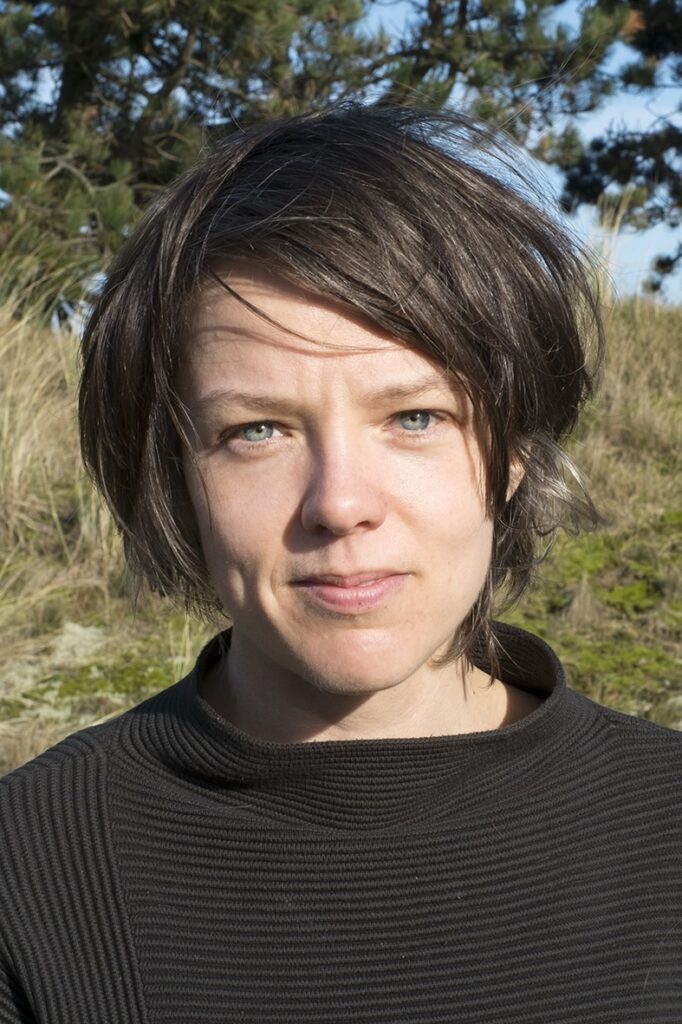
Paulien Oltheten
Paulien Oltheten analyzes human behaviour in public space, often in direct contact with passers-by. With candid openness she seeks out situations that allow her to emphasizing poetic or rhythmic details: people maneuvering awkward luggage, careless ritual movements, remarkable postures or repetitive routines that leave visual marks on their surroundings. Like a contemporary urban anthropologist, Oltheten documents such acts and patterns – often subtly connected to a specifically chosen location or context. She then structures and annotates her research materials to craft a perceptive narrative in the form of photography and video, publications, lectures and performances.
Since 2029 she is affiliated artist at SoAP ( Space oriented Artistic Practice) and with their support she will travel coming years in stages along the former border between Eastern and Western Europe. She begins in Kirkenes, at the northernmost point of Norway, and continues along the Iron Curtain Trail through Finland, Estonia, Latvia, Germany and Hungary, all the way to the Black Sea.
Alternating between the handlebars of her bicycle and her (film) camera, she observes everyday human life as well as the more-than-human life unfolding along and around this historically charged frontier.
Oltheten studied at the Royal Academy of Arts and Design in ’s-Hertogenbosch (2000-2004) and the Rijksakademie van beeldende kunsten in Amsterdam (2005-2006). Her work has been shown at, among others, the Stedelijk Museum (Amsterdam), Nederlands Fotomuseum (Rotterdam), Galerie Fons Welters (Amsterdam), Jeu de Paume (Paris), Moscow Museum of Modern Art, and the Museum of Contemporary Photography (Chicago).She won the Dutch Doc Award (2012) and Nouveau Prix Découverte des Rencontres d’Arles (2018); past residencies include American Academy in Rome ( 2025), Cité internationale des arts in Paris (2017) and ISCP New York (2013).
Partners and contexts
We collaborate with universities, cultural organisations, arts education networks, civic organisations, public institutions, mission-driven teams, and corporate organisations who want to strengthen leadership capacity, governance, and culture in complex environments, sometimes entering an existing programme and sometimes co-designing a new trajectory. Across contexts, the work is designed for return, revision, and shared responsibility, so that learning can remain alive when conditions shift, conflict arises, or pressure increases.
